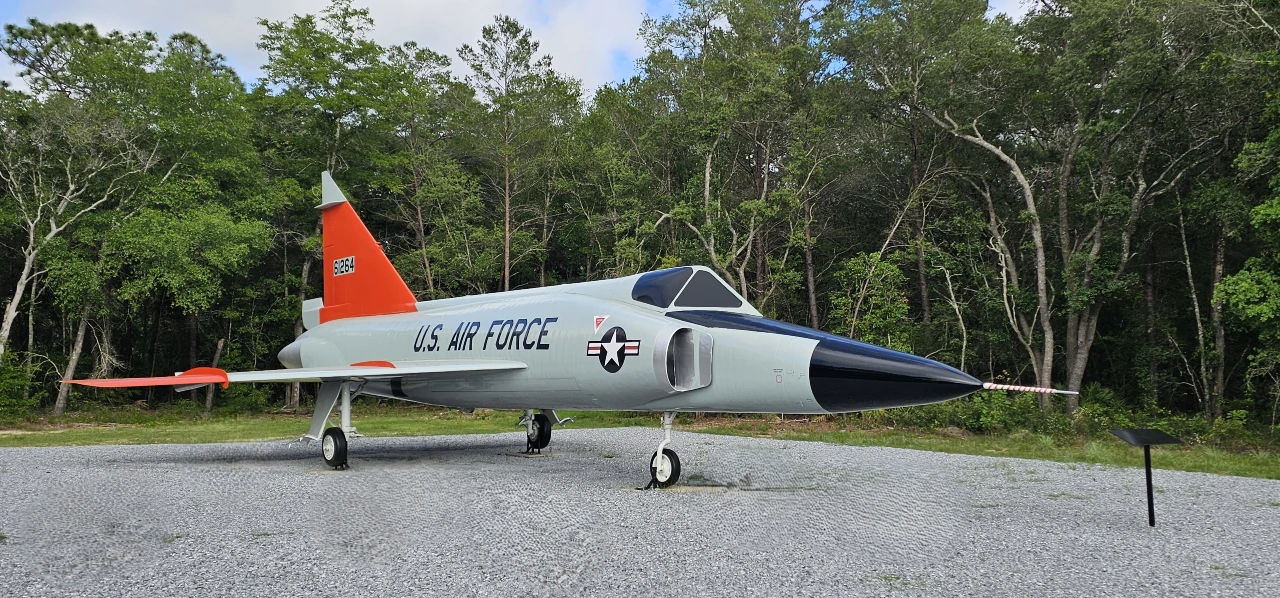
The General Dynamics Convair F-102 Delta Dagger was the world’s first supersonic all weather jet interceptor and the first operational Mach I delta-wing aircraft in the U.S. Air Force’s. Affectionately known as “the Deuce,” the F-102’s mission was to intercept and destroy enemy aircraft. Its wasp-waisted delta wing technology was inspired by German scientists during World War II.
The F-102 made its initial flight on 24 October 1953 during the height of the Cold War. The Deuce’s high-speed and high-altitude capabilities made it valuable against to the Soviet bomber force. By 1956 the Deuce became operational with the Air Defense Command and equipped more than 25 Air Defense Command squadrons. Convair built 1,101 Delta Daggers, with 975 being F-102As.
The F-102 saw limited use during the Vietnam War during 1962-69 as an air defense interceptor and as an escort for B-52 Stratofortress bombers. One Deuce was lost to a North Vietnamese MiG-21 in combat. Another 14 were lost in sapper attacks and accidents.
When the F-102’s onboard electronic equipment located an enemy aircraft, the Delta Dagger’s radar would guide it into position for attack. Then, at the right moment, the aircraft’s electronic fire control system automatically fired its air-to-air rockets and missiles.
After its mission as an interceptor, the F-102 was assigned a new mission. In 1973 Sperry corporation was contracted to convert more than 200 obsolete F-102A Delta Daggers to unmanned target drones under the Pave Deuce Program. These drones simulated realistic supersonic threats, such as the Russian MIG-21, so fighter pilots could practice live-fire missile training.
They were initially designated (Q-F-102A or PQM-102A). The QF-102 were dual control target drones that could be flown by pilots onboard for ferry flights and testing. The PQM-102A was reconfigured to be flown unmanned.
This aircraft, (SN 56-1264) was assigned to the Connecticut Air National Guard (1970-71) where it stood 24-hour Air Defense Command alert fully armed with air-to-air Falcon missiles and 2.75-inch rockets. Following that assignment, it was converted to a QF-102A drone that was part of a contingent at Eglin AFB.
SPECIFICATIONS PERFORMANCE
Wingspan: 38 ft., 1 in. Max.
Speed: 810 mph.
Length: 68 feet, 4 in.
Cruise Speed: 600 mph.
Height: 21 ft., 2 in.
Range: 1,000 miles.
Weight: 31,559 lbs., max.
Service Ceiling: 55,000 ft.
Sources:
• National Museum of the United States Air Force
• March Field Historical Museum
• Directory of U.S. Military Rockets and Missiles