
The second edition of Projectile is here!
The Air Force Armament Museum Foundation is proud to present its second edition of Projectile, a newsletter commemorating development and employment of weapons delivery from the air. If you missed the inaugural edition, visit News & Events | Air Force Armament Museum Foundation where you can also register to receive future newsletters.
For this second edition, we’re sharing the history of the BLU-82/B a museum artifact since 2019. Look for an upcoming edition of Projectile to focus on the Air Force Research Laboratory and evolution of smart weapons.
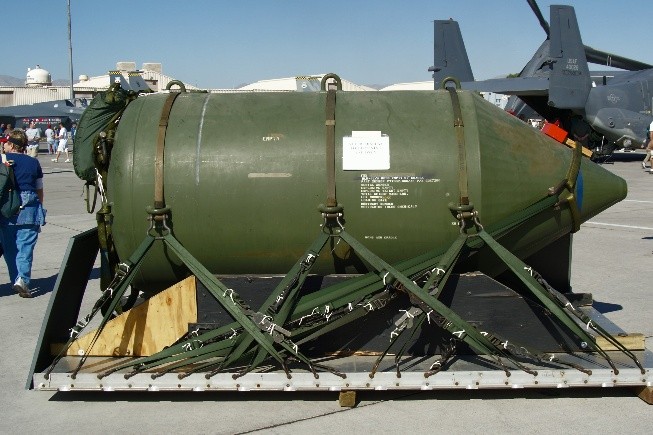 Development of 15,000 lb. BLU-82/B began in 1969. From the beginning, its design differed greatly from traditional bomb configuration. While some standard bomb components were used, the casing was an adapted propane tank made of ¼” mild steel capped with a ½” formed steel nose. The explosive fill was the most non-standard characteristic. Unlike conventional bombs loaded with “melt cast” Trinitrotoluene (TNT) or Tritonal, the BLU-82/B used an ammonium nitrate based energetic known as Gelled Slurry Explosive (GSX) which is roughly 82% as powerful as TNT. Energetic constituents were typically 56.10% ammonium nitrate, 24.18% aluminum powder, 19.6% water and 8% gellant. Ammonium Nitrate is a common agricultural fertilizer; so, in lay terms, it is a big fertilizer bomb. According to an Air Force Armament Laboratory report dated April 1972, GSX had several advantages in comparison with conventional “melt cast” explosives. The biggest advantage; GSX was cheap to produce, could be mixed and loaded at the deployed location, and could be loaded at ambient temperature. Another convenience and safety factor was GSX can be non-explosive until mixed (easier to ship). The downside of GSX was a 1-year shelf life once filled. A total of 225 BLU-82/B bombs were produced at a cost of $1,040,000.
The BLU-82/B was designed to explode above the surface to maximize blast effect against vegetation found in Southeast Asia. To help maximize blast effect, the BLU-82/B was designed to use either an M1 or M1A1(E-1) fuze extender, which are both 36” long. The fuze extender coupled with a standard M904 nose fuze, and a T45E7/M148 nose adapter booster provided an above ground burst capability. Above ground burst capability was desired not only to maximize blast effect against trees, but also to limit the size of the crater created by the blast (remember, helicopters needed to land there).
Historical Note: Though the BLU-82/B is commonly referred to as “Daisy Cutter”, the term existed well before the BLU-82/B was developed. The “Daisy Cutter” moniker centered on a three-foot M1 fuze extender typically mounted on conventional General-Purpose bombs. M1 fuze extenders were especially useful to initiate explosive function above the surface in muddy or wet terrain. During the war in Vietnam, the BLU-82/B became synonymously known as “Daisy Cutter,” but in historical context, any bomb equipped with an M1 or M1A1(E-1) fuze extender was known as a “Daisy Cutter.”
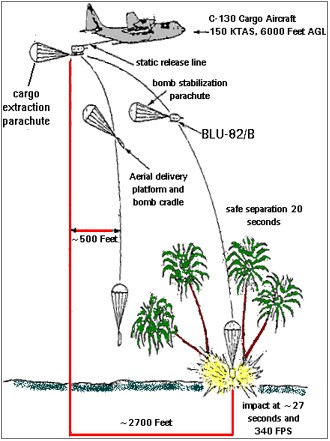 Prior to loading GSX, the bomb body was positioned on wooden cradle, then strapped to a standard 463L pallet. A parachute was attached to the rear of the bomb to provide stabilization during descent. After being loaded onto the aircraft, the bomb was locked in place and fuzed. Once airborne and over target at 6000 feet above ground, the entire assembly was extracted from the aircraft via an extraction chute. Once clear of the aircraft, straps were automatically cut while the stabilizing chute deployed, which released the bomb from the cradle and pallet.
When it was all said and done, the BLU-82 would normally create a clearing of about 260 feet in diameter. Depending on the size of trees needing to be cleared, engineering work was sometimes needed to remove rogue trees.
According to a Sandia Laboratories report, the BLU-82/B “provided immediately usable HLZs capable of accommodating from one to three UH-1 (Huey) helicopters. Single HLZs were created in densely foliated areas, clearing trees as large as 4 feet in diameter and 150 feet tall. Almost no debris pile up was noted at the zone perimeters.” Accompanying the clearing was a shallow crater formed by the explosion. As witnessed in 1969 during a drop on Tonopah test range in Nevada, a BLU-82/B detonation created “a concave depression, 6 to 12 inches deep at the center and 20 to 30 feet in diameter.” The shallow crater normally contains a sizable quantity of pulverized soil, somewhat resembling dirty talcum powder.
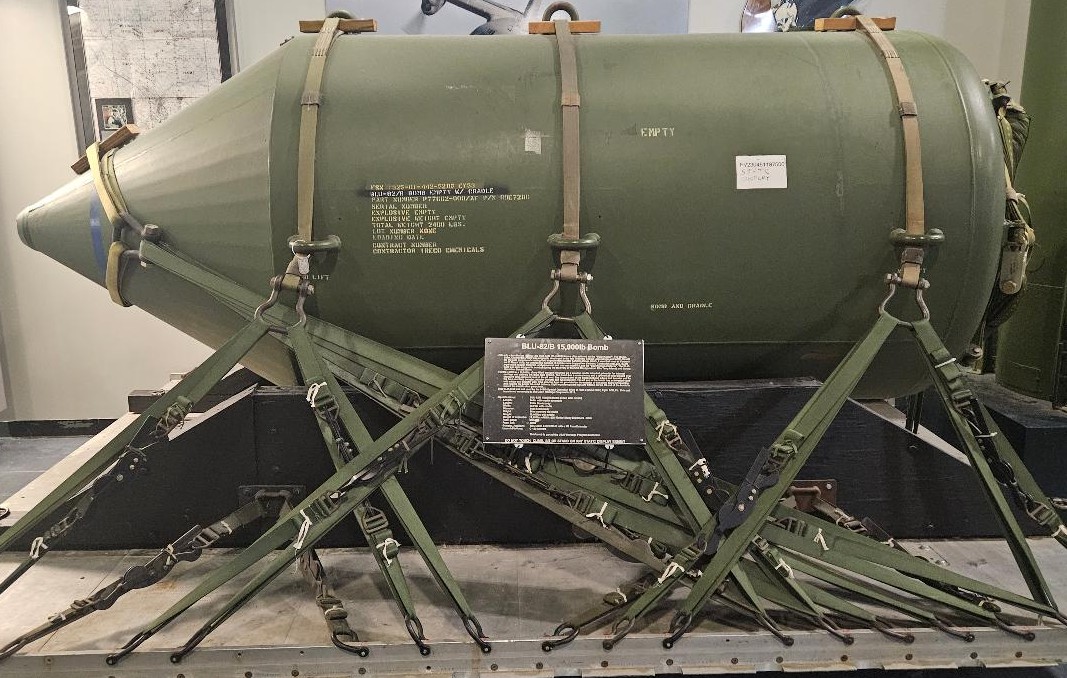 The BLU-82B on display at the museum was last used by the 919 Special Operations Wing at Field 3, Duke Field, Eglin AFB FL before becoming an Air Force heritage asset in 2019.
If aviation and air armaments inspire you, consider becoming a Friend of the Museum and donating annually to the Air Force Armament Museum Foundation, a 501(c)(3) nonprofit dedicated to advancing the museum’s mission. All donations are used to support acquisition and restoration of museum artifacts and are greatly appreciated. You can donate by check at the address below or by credit card/PayPal at the link. Thank you!
Friends of the Museum: Student $15 Adult $25 Family $50
Air Force Armament Museum Foundation, Inc.
100 Museum Drive
Eglin AFB, FL 32542 US
A copy of the official registration and financial information may be obtained from the Division of Consumer Services by calling the toll-free number, 1-800-HELP-FLA (435-7352) or by viewing the website FDACS.GOV within the State. Registration does not imply endorsement, approval, or recommendation by the State. Registration #CH220.