The Air Force Armament Museum Foundation is honored to partner with the museum staff and volunteers who preserve and present the heritage of air armaments at Eglin Air Force Base, Florida. The Foundation presents Projectile, a newsletter commemorating development and employment of weapons delivery from the air. We launch this inaugural edition of Projectile as America celebrates 250 years since the signing of the Declaration of Independence.
For this first edition, we’re proud to spotlight the Convair F-102 Delta Dagger, known as the “Deuce”. Look for a wide range of air armament stories in future issues.
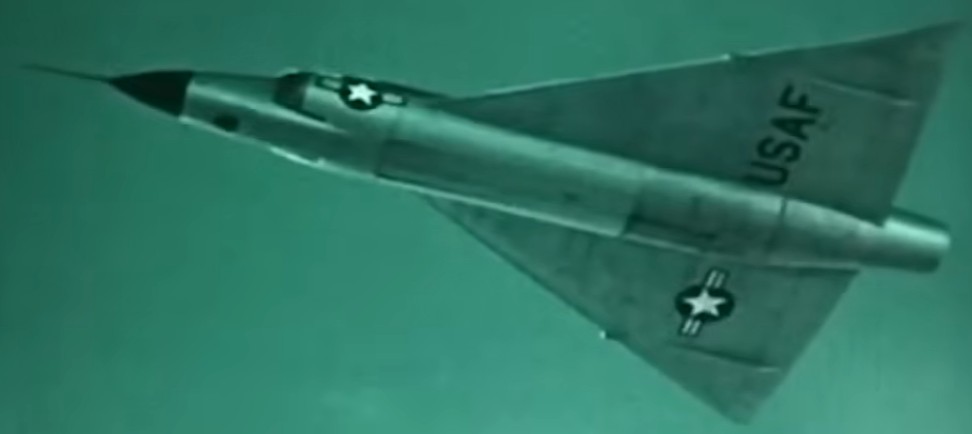
Entering service in 1956 as the world’s first supersonic turbojet, all-weather interceptor, the F-102 was also the first all-missile armed aircraft. The Deuce carried up to six Falcon air-to-air missiles in its internal weapons bay plus 24 rockets. Equipped with MG-10 radar and fire control system and data link enabled ground control intercept (GCI) with the Semi-Automated Ground Environment (SAGE) system. Mods to the original design at Eglin AFB improved supersonic performance. The Deuce saw service during the Cold War and flew bomber escort missions in Vietnam.
Measuring 68 feet with a 38-foot wingspan, the Deuce had a 55,000-foot ceiling and cruising speed of 600 miles per hour. The aircraft’s distinctive delta wing and absence of horizontal tail surface enabled high altitude performance, relying on its wings for stability. F-102s were assigned to 25 air defense squadrons in the continental United States and overseas.
Design issues necessitated modifications to overcome F-102A jet engine problems and transonic drag as well as fire control system (FCS) limitations. Eglin Air Force Base played a central role, refining the entire weapon systems test process in the course of these improvements. The F-102B “Ultimate Interceptor” led to development of the F-106 Delta Dart which flew at speeds of Mach 2.
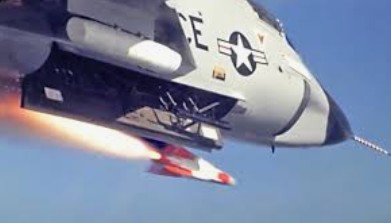 “Deuce” fires a Falcon guided missile. The Hughes GAR-4 Falcon came in two variants: the AIM-4A radar guided missile and the AIM-4D using infra-red (heat-seeking) guidance. Although the F-102 served primarily as an interceptor, 24 2.75-inch (70mm) “Mighty Mouse” folding fin aerial rockets (FFARs) could be carried for air to ground raids and used against enemy movement along the Ho Chi Minh Trail in Vietnam.
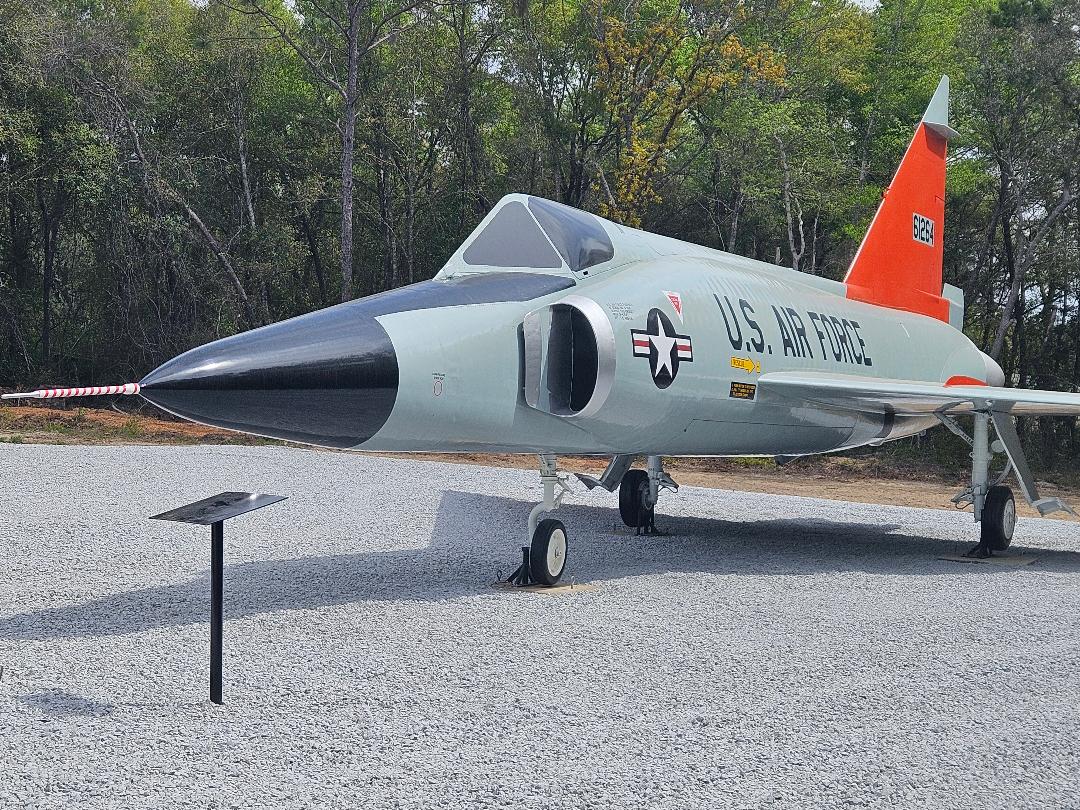 The bottom center rail of an F-102 could carry an AIM-26A air-to-air missile armed with a kiloton-range nuclear warhead to engage an enemy aircraft formation.
Acquired from the Connecticut Air National Guard, the museum’s F-102A, tail # 61264 was disassembled and shipped to Eglin AFB in 2025. With a superb paint job, the Deuce is displayed next to three other “Century Series” fighters–the F-100, F-101, and F-104.
If aviation and air armaments inspire you, consider becoming a Friend of the Museum and donating annually to the Air Force Armament Museum Foundation, a 501(c)(3) nonprofit dedicated to advancing the museum’s mission. All donations are used to support acquisition and restoration of museum artifacts and are greatly appreciated. You can donate by check at the address below or by credit card/PayPal at the link. Thank you!
Friends of the Museum: Student $15 Adult $25 Family $50